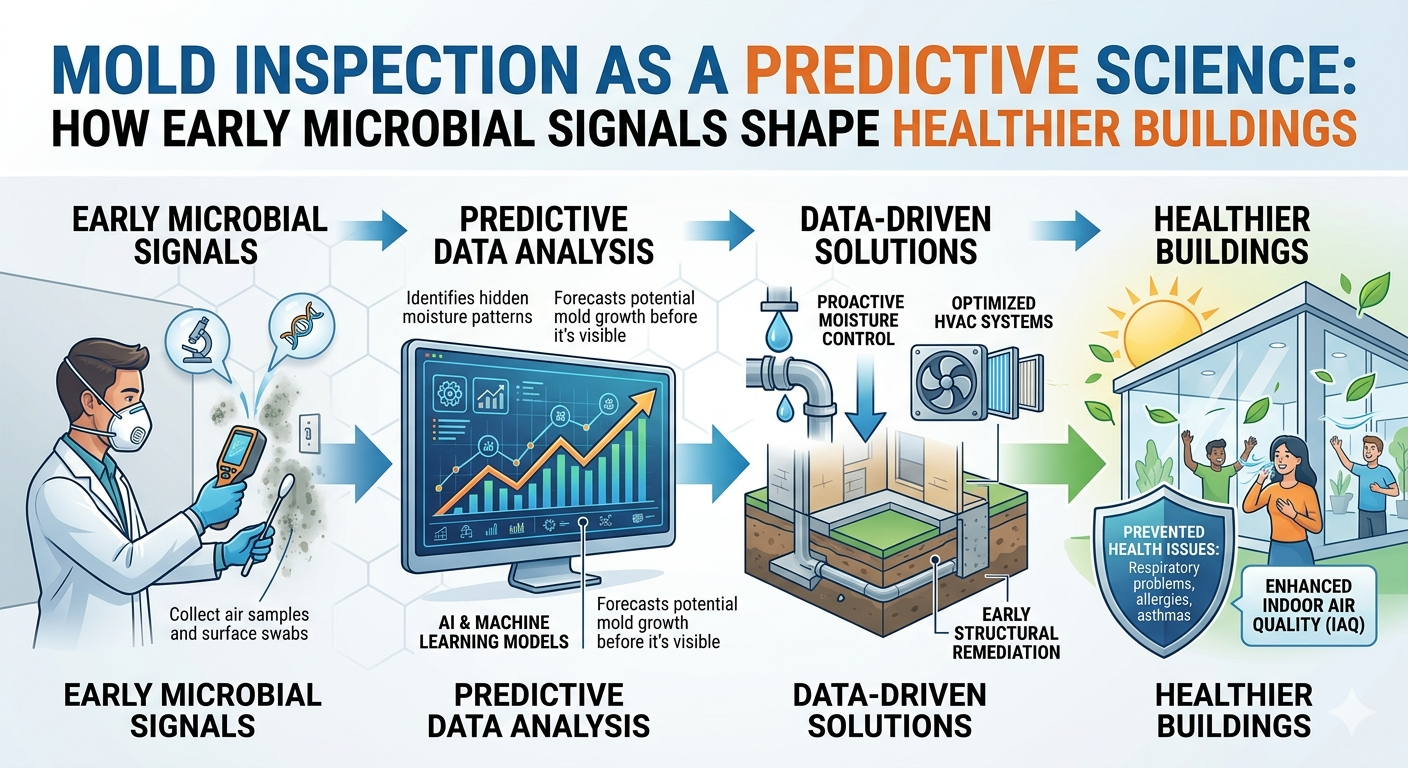
Mold Inspection as a Predictive Science: How Early Microbial Signals Shape Healthier Buildings
When people think about mold, they usually picture visible patches on walls or a musty odor that signals something has already gone wrong. We approach mold inspection from a different angle. Instead of reacting to what is obvious, we focus on what is emerging, subtle, and often overlooked. At Fun Guy Inspections, we treat mold inspection as a predictive science rather than a reactive service.
Moving Beyond Visible Mold
Traditional inspections often begin and end with what can be seen. While surface-level identification is important, it rarely tells the full story. Mold is a biological system that thrives on moisture dynamics, airflow patterns, and material composition. By the time it becomes visible, it has often been active for weeks or even months.
We focus on identifying precursor conditions. These include microclimates behind walls, humidity gradients within insulation, and condensation patterns near thermal bridges. By analyzing these early indicators, we can detect mold risks long before they manifest physically.
The Role of Microclimates in Mold Growth
Every building contains dozens of micro-environments. Some areas trap humidity, while others remain dry and stable. Mold does not grow uniformly. It selects niches where moisture, temperature, and organic material align perfectly.
We map these microclimates using targeted inspection techniques. For example, areas behind cabinetry, beneath flooring transitions, and inside HVAC cavities often behave very differently from open spaces. Understanding these hidden zones allows us to predict where mold is most likely to develop.
Airflow as a Hidden Driver
Air movement inside a building plays a critical role in mold distribution. Poor ventilation can trap spores in localized zones, while imbalanced airflow can transport moisture into unexpected areas.
We analyze airflow patterns as part of our inspection process. This includes identifying pressure differences between rooms, evaluating return air pathways, and assessing how ventilation systems interact with structural design. By doing so, we uncover how mold spores travel and where they settle.
Moisture Mapping Instead of Spot Checking
Many inspections rely on isolated moisture readings. While useful, this method can miss broader trends. We use moisture mapping to create a more comprehensive picture. Instead of a single data point, we analyze patterns across surfaces and materials.
This approach reveals how moisture moves through a building over time. It helps us identify chronic issues such as slow leaks, vapor intrusion, or seasonal condensation cycles. These are often the root causes of recurring mold problems.
Material Sensitivity and Mold Risk
Not all building materials respond to moisture in the same way. Drywall, wood, and composite materials each have unique absorption and retention properties. Some materials can support mold growth even with minimal moisture exposure.
We evaluate material sensitivity as part of our inspection. By understanding how different surfaces interact with moisture, we can assess which areas are most vulnerable. This allows us to recommend targeted interventions rather than broad, unnecessary treatments.
The Importance of Time in Mold Development
Mold growth is not just about moisture. It is also about duration. A short-term leak may not lead to significant growth, but prolonged exposure creates ideal conditions for colonization.
We consider time as a critical variable. This includes analyzing historical usage patterns, past water events, and seasonal changes. By reconstructing a timeline, we gain insight into how mold conditions developed and how they can be prevented in the future.
Data Driven Inspection Techniques
Modern mold inspection is evolving rapidly. We integrate data driven methods to enhance accuracy and reliability. This includes advanced moisture detection tools, thermal imaging for identifying hidden dampness, and air sampling for detecting elevated spore levels.
These tools allow us to move beyond assumptions. Instead of guessing, we rely on measurable data to guide our findings. This ensures that our recommendations are precise and actionable.
Preventive Strategies That Actually Work
Inspection is only one part of the process. The real value lies in prevention. Based on our findings, we develop strategies that address the root causes of mold growth.
This may include improving ventilation, sealing air leaks, adjusting humidity control systems, or modifying material usage in vulnerable areas. The goal is to create an environment where mold cannot thrive, rather than repeatedly treating symptoms.
Why a Predictive Approach Matters
A predictive approach changes the entire dynamic of mold management. Instead of waiting for damage to occur, we help property owners stay ahead of the problem. This not only protects the structure but also supports healthier indoor environments.
At Fun Guy Inspections, we believe that mold inspection should provide clarity, not just confirmation. By focusing on early signals, environmental patterns, and scientific analysis, we deliver insights that go far beyond surface level observations.
Building Health Starts with Awareness
Mold is often misunderstood as a simple issue with a simple fix. In reality, it is a complex interaction of environmental factors that requires a thoughtful approach. By understanding how and why mold develops, we empower property owners to make informed decisions.
Through our work, we aim to shift the conversation from reaction to prevention. A building that is monitored, analyzed, and maintained with precision is far less likely to experience serious mold issues.
That is the difference a true mold inspection expert brings to the table.