Understanding the Limits of One Air Sample
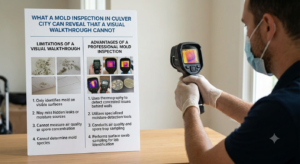
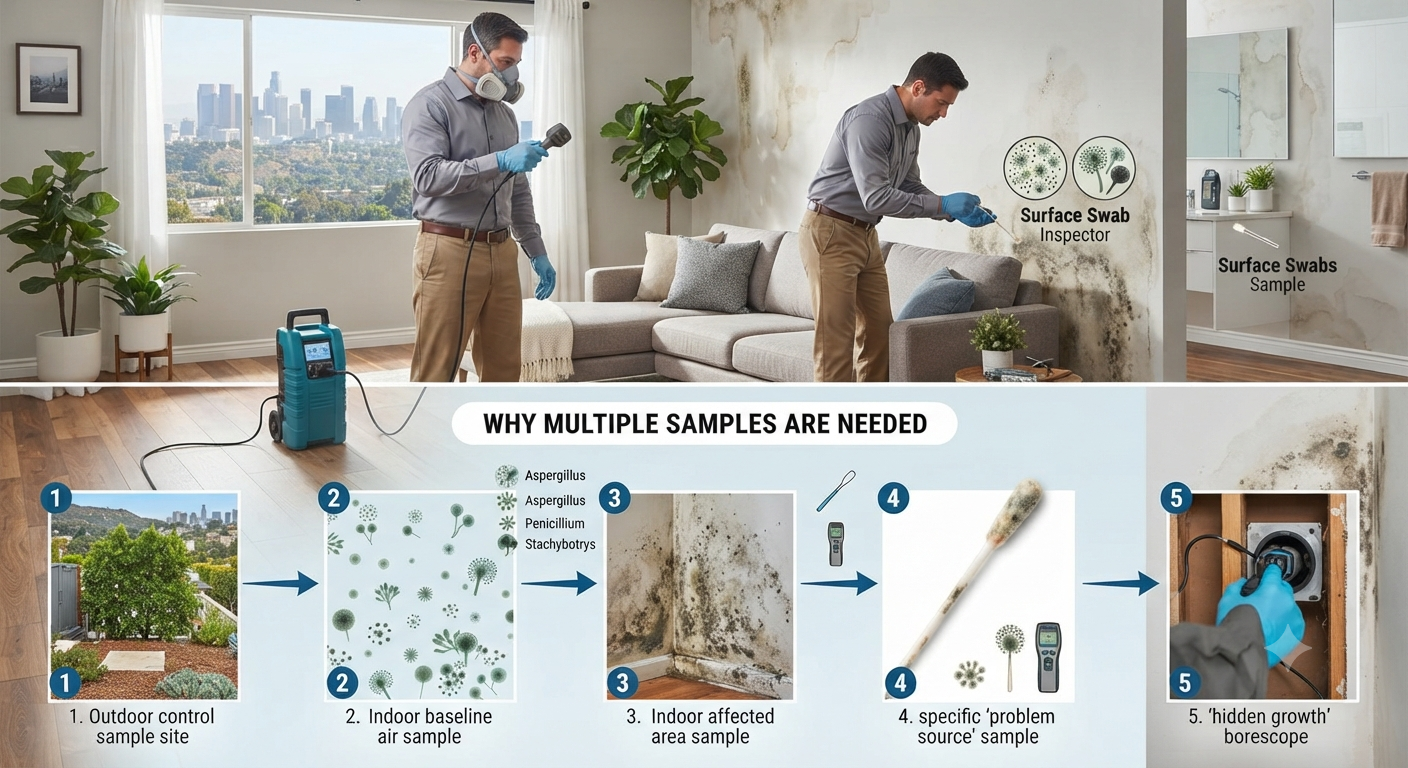
Mold testing in Los Angeles can involve more than collecting one air sample because indoor mold conditions are often complex and difficult to represent with a single measurement. An air sample captures what is airborne at a particular location and moment, but it may not reveal mold growing behind walls, beneath flooring, inside cabinets, or around hidden moisture sources. Mold spores can also vary throughout a building depending on ventilation, humidity, temperature, occupant activity, and air movement. A single sample may therefore provide useful information without telling the complete story of what is happening throughout the property. We consider the building’s history, visible conditions, moisture patterns, odors, and sampling locations when determining whether additional investigation is appropriate. This broader approach helps ensure that testing results are interpreted within the actual conditions of the property.
Why Location Matters During Mold Testing
The location where an air sample is collected can significantly influence the information it provides. A sample taken in one bedroom may not reflect conditions in a basement, bathroom, crawlspace, attic, or area affected by a previous plumbing leak. Different rooms can have different ventilation patterns and moisture levels, which may influence the concentration and distribution of airborne spores. Even within the same room, air conditions can change depending on whether doors and windows are open, HVAC equipment is operating, or people are moving through the space. For this reason, mold testing may require strategically selected sampling locations rather than relying on a single point. Our goal is to understand whether the available evidence represents the property as a whole or whether specific areas deserve closer attention.
Hidden Mold May Not Be Captured in the Air
One of the most important limitations of air sampling is that mold does not always release large quantities of spores into the air. Mold can grow on concealed materials while airborne concentrations remain relatively unremarkable at the time of testing. Moisture behind drywall, under flooring, around plumbing penetrations, inside wall cavities, or within HVAC components can create conditions that deserve investigation even when an air sample does not indicate an obvious problem. A localized growth area may also be physically separated from occupied areas, limiting the number of spores that reach the sampled air. Consequently, a normal or inconclusive air sample does not automatically establish that there is no mold present. We look at the relationship between sampling results and the physical condition of the property before drawing conclusions.
Moisture Investigation Is an Important Part of the Process
Mold growth is closely associated with moisture, making the identification of water sources an important component of a thorough inspection. In Los Angeles properties, moisture problems can arise from plumbing failures, roof leaks, poor drainage, condensation, HVAC issues, elevated indoor humidity, or previous water damage. Some moisture problems are intermittent, meaning the affected material may appear dry when an inspection takes place even though repeated exposure has occurred. Moisture readings, visual observations, building history, and information about previous repairs can therefore provide important context that an air sample cannot supply. If a property has evidence of a moisture problem, additional evaluation may be appropriate even when one air sample appears reassuring. We use the available evidence to determine whether the observed conditions warrant further investigation.
Los Angeles Buildings Can Have Different Environmental Conditions
Los Angeles has a wide variety of residential and commercial buildings, and each property can present different environmental factors that influence mold conditions. Older buildings may contain areas that have experienced years of repairs, remodeling, plumbing changes, or previous water intrusion. Newer properties can also experience moisture problems when construction details, ventilation, drainage, or mechanical systems do not perform as expected. Coastal areas may experience different humidity patterns than inland communities, while individual buildings can create their own microenvironments based on insulation, ventilation, occupancy, and HVAC operation. These differences make it difficult to apply a single testing approach to every property. A careful inspection considers the specific building rather than assuming that one sample can answer every question.
Airflow Can Influence Sampling Results
Air movement is another reason a single air sample may provide only a limited picture of indoor conditions. HVAC systems can move air between rooms and potentially distribute particles from one area to another, while closed doors can restrict movement and create differences between spaces. Windows, fans, exhaust systems, and changes in indoor activity can also affect how airborne particles are distributed. If mold is concentrated in an isolated area, the air in another part of the building may not accurately reflect that localized condition. Conversely, an HVAC system may transport particles beyond their original source, creating a broader pattern that requires careful interpretation. We consider airflow and building configuration when determining whether the sampling strategy adequately addresses the concerns identified during an inspection.
Visible Evidence Can Change the Testing Strategy
Visible staining, discoloration, damaged materials, peeling finishes, or suspected fungal growth can provide information that should not be ignored simply because an air sample is available. Physical evidence may identify a specific area that requires closer evaluation or may point toward a history of moisture exposure. An air sample is most useful when its results are considered alongside what can be observed throughout the property. If there are suspicious conditions in multiple locations, collecting information from only one area may leave important questions unanswered. We document relevant observations and consider whether additional sampling or investigation would provide a more representative assessment. This helps keep the testing process focused on the actual concerns affecting the building.
Different Areas May Need Different Attention
A property is not necessarily an environmentally uniform space, particularly when it contains multiple floors, additions, enclosed areas, or rooms with different uses. Bathrooms may have recurring condensation, kitchens can experience elevated moisture from cooking, and laundry areas may develop localized humidity problems. Attics and crawlspaces can have their own ventilation and moisture conditions that differ substantially from occupied rooms. HVAC closets, utility spaces, and areas around plumbing can also require attention when there is evidence of water intrusion or unusual odors. Testing several strategically selected areas can help determine whether conditions are localized or more widespread. We evaluate the layout and history of the property before deciding whether additional samples would contribute meaningful information.
Comparing Indoor and Outdoor Conditions
Mold investigations sometimes involve comparing indoor conditions with an appropriate outdoor reference sample because outdoor air naturally contains fungal spores. The comparison can provide context for interpreting indoor findings, but it still needs to be considered alongside the circumstances of the building. Outdoor concentrations can fluctuate based on weather, season, vegetation, wind, and other environmental factors. A single outdoor reference therefore does not automatically explain every indoor result. When multiple indoor locations have substantially different conditions, additional sampling may help establish a clearer picture of how those areas compare. We interpret sampling results as part of an overall assessment rather than treating one number as a definitive answer.
Previous Water Damage Can Be an Important Clue
A property’s history can be just as important as its present appearance when evaluating potential mold concerns. A previous roof leak, burst pipe, appliance failure, flooding event, or recurring condensation problem may have affected building materials before visible repairs were completed. Materials that were not adequately dried or replaced can remain vulnerable to microbial growth even after the original moisture source has been corrected. A single air sample collected long after the event may not capture the full significance of that history. Information about when the water damage occurred, how it was addressed, and which materials were affected can help determine where additional attention may be appropriate. We use this history to build a more complete understanding of potential moisture and mold conditions.
Odors Should Be Investigated in Context
Musty or unusual odors can sometimes indicate moisture or microbial activity, although odor alone cannot establish the presence, type, or extent of mold. When an odor is localized to a particular room or area, identifying the source can be more useful than simply relying on a single air sample from another location. Hidden moisture, damp materials, or poorly ventilated spaces may contribute to odors without producing a straightforward airborne result. If occupants report recurring odors that disappear and return under certain conditions, the timing and location of those observations can also provide valuable clues. We consider reported odors together with visual observations, moisture information, ventilation, and sampling results. This integrated evaluation can help identify situations where one sample does not adequately address the underlying concern.
More Testing Does Not Always Mean Better Testing
Although multiple samples can sometimes be appropriate, collecting additional samples without a clear reason does not necessarily make an inspection more useful. The objective should be to obtain representative information that addresses specific questions about the property. Sampling locations should be selected based on building layout, suspected moisture sources, visible conditions, occupancy concerns, and other relevant factors. Randomly increasing the number of samples can create unnecessary expense without providing meaningful additional insight. We focus on the question that needs to be answered and determine whether additional sampling can realistically help answer it. This keeps the inspection evidence based and avoids treating a larger sample count as a substitute for professional interpretation.
When Additional Evaluation May Be Appropriate
There are several circumstances in which a single air sample may not adequately address the concerns surrounding a property. Multiple areas may show signs of water damage, occupants may report persistent odors in different rooms, or a suspected moisture source may be located far from the original sampling point. A property may also have a complicated history involving previous remediation, recurring leaks, flooding, or renovations that concealed affected materials. In these situations, evaluating additional locations or gathering other forms of evidence can help clarify the condition of the building. The appropriate approach depends on what is discovered during the inspection rather than on a predetermined number of samples. Our priority is to obtain information that is relevant, representative, and useful for understanding the property’s condition.
Choosing a More Complete Mold Assessment
A reliable mold assessment should begin with the property itself rather than with the assumption that one test can answer every question. Air sampling can be valuable, but it is only one component of an investigation and should be interpreted within the context of building conditions. Visual inspection, moisture assessment, environmental observations, property history, airflow considerations, and strategically selected sampling can work together to provide a stronger understanding of potential concerns. When evidence points toward a localized or hidden problem, additional investigation may be more informative than relying on a single air result. We explain what the available evidence indicates and where uncertainty remains so that property owners can make informed decisions. Fun Guy Inspections approaches mold concerns with the understanding that meaningful answers often require looking beyond one sample and evaluating the building as an interconnected system.
Making Sense of Mold Testing Results
Mold testing results should never be viewed in isolation from the conditions under which the samples were collected. A laboratory report can provide analytical information, but interpreting that information requires consideration of the sampling location, building conditions, environmental factors, and reason the testing was performed. Results from one room may have limited relevance to a separate area with different moisture or ventilation conditions. Similarly, an absence of significant findings in one sample does not necessarily eliminate the possibility of a concealed or localized issue elsewhere. Understanding these limitations can prevent property owners from placing too much confidence in a single test result. We believe the most useful assessment is one that connects testing information with observations from the entire property.
A Property Focused Approach Provides Better Context
The purpose of mold testing should be to answer practical questions about a building, not simply to produce a laboratory report. When conditions are straightforward and the sampling location is representative, one sample may sometimes provide useful information. When the property has multiple concerns, however, additional samples or other inspection methods may be warranted to understand what is happening in different areas. This is particularly important when there are signs of moisture, hidden damage, unusual odors, or a history of water intrusion. A thoughtful testing strategy balances the need for reliable information with the need to avoid unnecessary procedures. Fun Guy Inspections helps property owners understand why testing requirements can vary and why a broader evaluation may sometimes be necessary to reach a well-supported conclusion.
Conclusion
Los Angeles mold testing can require more than a single air sample because buildings contain different rooms, materials, airflow patterns, moisture conditions, and histories of environmental exposure. One air sample provides information about one specific point in time and space, but it may not represent conditions elsewhere in the property. Hidden mold, localized moisture, previous water damage, ventilation patterns, and visible evidence can all influence how an inspection should be approached. Additional sampling may be useful when it addresses a specific unanswered question, while other inspection methods may be more appropriate in different circumstances. The strongest assessment comes from interpreting all relevant evidence together rather than relying on one isolated result. Fun Guy Inspections takes a property focused approach designed to help clients understand what their testing results mean and whether additional investigation may be appropriate.