
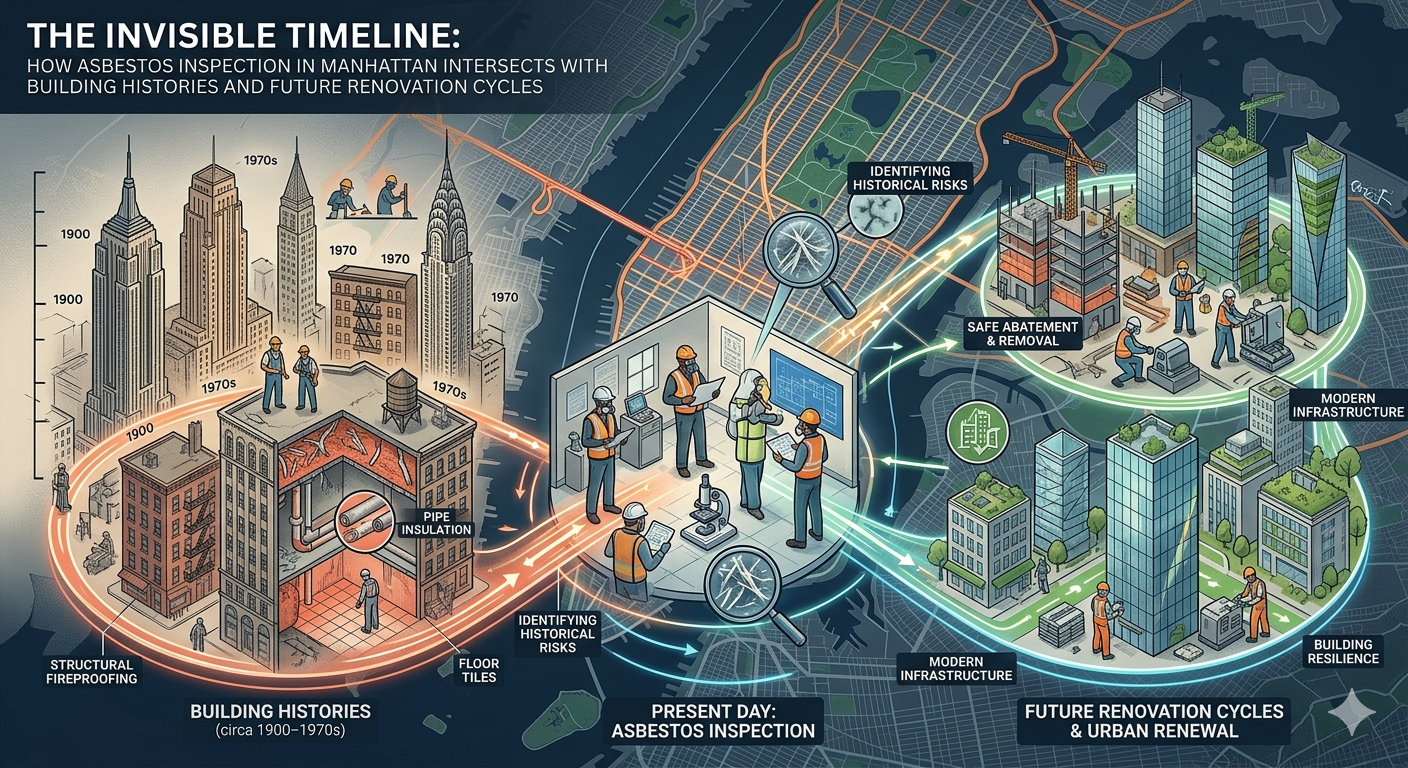
How Asbestos Inspection in Manhattan
In a city like Manhattan, every building carries a timeline. Beneath the polished facades, behind modern renovations, and within structural layers, there are materials that tell stories of past construction eras. One of the most critical yet often overlooked components of that timeline is asbestos. At Fun Guy Inspections, we approach asbestos inspection not as a routine checklist, but as a deep analysis of a building’s material evolution and its implications for future use.
Understanding Manhattan’s Layered Construction Legacy
Manhattan’s architectural landscape is unlike any other. Pre war brownstones, mid century high rises, and post modern commercial towers all coexist within tight urban grids. Many of these structures were built during periods when asbestos was widely used for insulation, fireproofing, and durability.
What makes asbestos inspection in Manhattan particularly complex is not just the presence of asbestos, but the way buildings have been modified over decades. Renovations often conceal or redistribute asbestos containing materials. Walls get opened and resealed. Ceilings are dropped. Mechanical systems are upgraded. Each change adds another layer to the building’s material history.
We focus on decoding that layered structure. Our inspections go beyond surface level checks and instead map out how past interventions may have impacted asbestos distribution.
The Concept of Material Drift in Urban Buildings
One of the most overlooked phenomena in older Manhattan properties is what we refer to as material drift. Over time, asbestos containing materials can shift from their original placement due to structural vibrations, HVAC system changes, or repeated renovations.
For example, insulation from older piping systems may deteriorate and migrate into wall cavities or ventilation pathways. Floor tiles containing asbestos may break down and mix with subfloor dust layers. These subtle shifts create contamination zones that are not immediately visible.
Our approach at Fun Guy Inspections includes identifying these drift patterns. By understanding how materials move within a structure over time, we can provide a more accurate assessment of risk and necessary remediation strategies.
Renovation Pressure and Hidden Risk Zones
Manhattan is constantly evolving. Renovation projects are not occasional events but continuous cycles. Property owners upgrade spaces to meet modern standards, improve value, or comply with regulations. However, renovation activity significantly increases the risk associated with asbestos.
Disturbing asbestos containing materials releases fibers into the air, creating serious health hazards. The challenge is that many renovation plans are designed without a full understanding of underlying material conditions.
We integrate asbestos inspection into the early planning phase of renovation projects. This allows us to identify hidden risk zones before any demolition or structural work begins. By doing so, we help prevent costly project delays, regulatory issues, and potential health exposure.
Micro Environments Within a Single Property
Another unique aspect of asbestos inspection in Manhattan is the existence of micro environments within a single building. Different floors, units, or sections of a property may have undergone renovations at different times, resulting in varied material compositions.
A single residential building might contain original asbestos insulation in basement piping, mid century ceiling materials on lower floors, and newer non asbestos finishes in upper level renovations. Treating the entire building as a uniform environment leads to inaccurate conclusions.
We conduct inspections that recognize these micro environments. Each zone is analyzed independently while also being considered as part of the overall building system. This granular approach ensures that no area is overlooked.

Regulatory Navigation in a Dense Urban Context
Manhattan operates under strict environmental and safety regulations when it comes to asbestos. Compliance is not optional, and violations can result in significant penalties. However, navigating these regulations requires more than basic knowledge.
Permits, documentation, and clearance procedures must align with city and state requirements. In densely populated areas, inspections also need to account for neighboring units, shared ventilation systems, and common spaces.
At Fun Guy Inspections, we guide property owners through this regulatory landscape. Our reports are structured to meet compliance standards while also providing practical insights for decision making.
The Role of Predictive Inspection Models
Traditional asbestos inspection methods focus on identifying current conditions. While this is essential, it does not fully address the dynamic nature of Manhattan buildings. We incorporate predictive models into our process.
By analyzing construction dates, renovation histories, and material usage patterns, we can anticipate where asbestos is likely to be present even before sampling begins. This targeted approach improves efficiency and reduces unnecessary disruption.
Predictive inspection also supports long term planning. Property owners gain a clearer understanding of future risks and can schedule remediation in alignment with renovation timelines.
Health Implications in High Density Living
In Manhattan, the impact of asbestos exposure is amplified by population density. Shared walls, ventilation systems, and common areas mean that contamination can affect multiple occupants.
Our inspections consider these interconnected environments. We assess how asbestos in one unit or section could influence adjacent spaces. This is particularly important for multi family residential buildings and commercial properties with shared infrastructure.
By addressing asbestos at a system level rather than an isolated point, we help protect not just individual occupants but entire building communities.
Integrating Inspection with Property Strategy
Asbestos inspection is often treated as a reactive measure. We believe it should be part of a proactive property strategy. Whether you are planning a renovation, purchasing a building, or managing a portfolio, understanding asbestos conditions is essential.
We work with property owners, developers, and managers to integrate inspection findings into broader decision making processes. This includes budgeting for remediation, scheduling construction phases, and ensuring long term compliance.
Why Our Approach Matters
At Fun Guy Inspections, we do not view asbestos inspection as a standalone service. It is part of a larger framework that connects building history, current conditions, and future plans.
Manhattan’s buildings are complex systems shaped by decades of change. Identifying asbestos within these systems requires precision, context, and forward thinking. Our methodology is designed to provide exactly that.
Final Perspective
Asbestos is not just a material issue. It is a timeline issue. In Manhattan, where buildings evolve continuously, understanding that timeline is critical. Inspection is the point where past construction meets future transformation.
We position our services at that intersection. By uncovering hidden material histories and aligning them with upcoming changes, we help property owners move forward with clarity and confidence.
If you are navigating renovation, acquisition, or compliance in Manhattan, a comprehensive asbestos inspection is not just advisable. It is foundational to making informed decisions in one of the most complex real estate environments in the world.